• A friend of mine is notoriously late for everything. We laugh about it and we wind her up but she just can’t help it. 

    Punctuality and her just don’t gel… It’s probably lucky that she’s an artist and forgiven for her terrible time keeping, it’s “part of the trade” she insists “we don’t follow clocks, we flow, we move according to our internal rhythm.” 

    And I like that. But I’ve been told I can also get away with being reasonably late too, because – apparently – it’s a ‘deaf thing.’ 

    Spend some time with the deaf community and you’re bound to come across the phrase deaf time. This loosely translates to – in my definition – deaf time: being usually late but normally with a good and/or interesting  excuse. Is awfully charming with the lateness so is difficult to stay mad at. 

    My hearing family didn’t believe me when I first told them it’s actually a thing but aside from being a bit of a joke and a ‘deaf-card’ to get you out of trouble, I actually think that being deaf does give you legitimate reasons for certain episodes of lateness. 

    And I don’t mean it in a silly “my chicken was ill” kind of way ๐Ÿ˜‰ but I’ve noticed that certain things do take longer to do because of my deafness. 

    Phone calls. They take longer to connect. Sometimes you have to “explain text relay” or deal with numerous hanger-uppers that aren’t familiar with Typetalk and mistake you for a cold caller. And let’s face it not all of us can type as quickly as we sign/speak. 

    Shopping trips. Especially with little ones in tow, that tap you and make you stop to lipread them. Using our eyes for everything we can’t multitask chit chat with shopping, it all takes longer. 

    Appointments of any kind. Whether we are using a communicator, interpreter or just plain old lip reading, the majority of us will take our time to make sure we are understood and also clear about what’s being said. It’s a different pace so we should allow more time. 

    Socialising. The deaf community don’t always see each other often; we are spread across the country. And we do miss our tribe. So when we do catch up, we catch up hard. So much to chat about, so little time! 

    Eating. Going out for a meal with my deaf friends / family usually lasts hours. We like to pause between courses, eating at a stop/sign/start rhythm (it’s rude to sign with your mouth full) and more often than not our food does end up cold. 

    Being immersed in something visually does mean you can lose track of time. So next time you’re a little late for something, providing you’re not just milking it, you might just have a viable reason. 

    You’re on deaf time. 

    But don’t push it. We don’t want to get a bad name for it do we ๐Ÿ˜‰

    What makes you guys late? 

  • I recall seeing a photo online a while back of Anthony, lead singer in Red Hot Chili Peppers, perform next to an American SignLanguage  interpreter. Social media went crazy with people desperate to know who the interpreter was – who actually now receives a fan following in her own right. Sassy, expressive and fully owning the song, she wasn’t just an interpreter, she was a performer

    And then here in Blighty  last summer, I noticed the buzzing of excitement amongst my deaf festival goer friends as they discovered their favourite artists would be performing with a – gasp! – sign language interpreter beside them. 

    We’ve had interpreters at musicals and theatre productions for a while now but at gigs… And rock concerts…? What’s going on? 

    Well, may I introduce Performance Interpreting who work across the UK delivering high quality, artistic sign language interpreters at various events… Specialising –  obviously – in performing arts ๐Ÿ˜‰

    Headed by full time interpreter, Marie Pascall, the company was  initially set up after seeing her friend refused Sign language access to a festival she wanted to attend. Recognising there was a huge gap in the music industry, Marie set to work encouraging venues and promoters to make their events accessible to the deaf community.

    The aim of Perofrmance Interpreting is to open as many doors as possible to provide quality access and social inclusion.  They also work with Deaf BSL Interpreters and Performers too. 

    And to ensure the company is led by its clients – so to speak – Performance Interpreting has recently set up a BSL steering group in conjunction with Attitude is Everything to ensure the deaf community are truly represented and have a real impact in accessible services going forward.

    And it seems all of her hard work is beginning to pay off. I was delighted to discover that the company, which was only formed a mere 18 months ago has landed some very exciting agreements. 

    And I’m thrilled to tell you guys about one of them. 

    If you ever want to attend a show at Nottingham’s Motorpoint arena, you can request an interpreter on your preferred attending date and they will provide one, courtesy of Performance Interpreting. 

    They also have BSL interpretations as part of their core programme too! See their access page here: 

    https://www.motorpointarenanottingham.com/Online/default.asp?BOparam::WScontent::loadArticle::permalink=accessibility&BOparam::WScontent::loadArticle::context_id=&menu_id=EB781A11-F20A-4C58-BE1D-685D821B2A85

    This is a world away from my concert going days when interpreters were usually just your best hearing friend that you had dragged along to tell you what the band were talking about in between the songs… This is kind of news is nothing short of groundbreaking. 

    And I must stress that the calibre of interpreters used by Performance Interprters  is outstanding.

    Performance Interpreters actually invited two of Limping Chicken’s biggest rock music fans to attend a signed interpreted Limp Bizkit & Korn concert. And to say that they were impressed by the service is an understatement.

    (See lovely William and Sammi below) 


    These guys, both deaf sign language users, are big on their music but had never attended a sign interpreted show before. I was curious… Would they enjoy it? Here’s what they had to say..

    “The interpreter was fantastic, she really learnt all the words and interpret them excellent. She was clear, and did really well with some really fast songs which I don’t think I could do!”

    Judging by the amount of preparation the interpreter, Susan Merrick, had to undertake before the show, I’m impressed and relieved that it all worked out. Because contrary to assumptions, concert interpreters don’t get given a band set list. At least not until 15 minutes before showtime – at the best of times! 

    For a band that performs 15-20 songs this means 20+ hours of study time for the interpreter – researching, learning, revising and translating lyrics. And knowing that theres no guarantee which song will be performed and possibly new ones premiered on the night, these are interpreters of a whole different league. 

    William and Sammi also mentioned that the interpreter did more than just sign the words…

    “She matched with the music, and swearing too. She even added the instruments sounds and pitch, which is really useful.”

    I saw a clip of Susan performing a song by Korn and I was mesmerised by how she depicted the sounds of the instruments. The staccato. The fluidity. The overlapping tones. They were all visible. And that was when I realised that Performance Intepreters really are opening doors – not just by providing access at concerts – but by delivering artistic translations of a high standard that actually do the songs justice. 

    I was fortunate enough to see a few other of their interpreters in action too and I can equally vouch for their are artistic excellence. After seeing them I felt like saying “Yes, finally! Someone gets it!” Because they fuse the BSL content with the lyrical meaning and their body becomes a rhythmical tool. 

    They have the ability  to introduce music to those who perhaps would usually turn away from it. And that’s powerful stuff. 

    That said. It is still early days and there are still improvements and adjustments to be made. The positioning of the interpreter at the concert isn’t ideal, and sadly nowhere near the stage… 

    “I would have liked to be in the crowd in standing area, and the interpreter possibly to stand by the stage as I like to see how they play their instruments. 

    Plus where we were in seating, we were at the back of the arena, just behind the standing, we had bit of trouble of seeing the band as there were some tall people which sort of blocking the view of stage. “

    I noticed that the placement of interpreters seems to differ; on some occasions they’re on stage but more than often they’re not. Personally speaking I would like the interpreter as close to the performer as possible. Which is why we – the deaf concert goers – need to speak up and work with the venues. 

    One person in particular who has worked with and for the deaf community remarkably well is Stephen Chaston – the Access Manager for Motorpoint Arena. 

    Stephen helped Motorpoint Arena to win an Outstanding Attitudeโ€™s Award and the arena has now been awarded a gold standard by Attitude is Everything who monitor accessiblity. They were recognised for their commitment to and excellent delivery of accessibly services. 

    Stephen’s aim is for as many Deaf British Sign Language Users to enjoy as many events as possible. So I am optimistic that the placement of interpreters could be easily resolved if discussions begin and more feedback is received. 

    The arena does have an access page on their website and details on their award from Attitude is Everything can be found here: 

    http://www.attitudeiseverything.org.uk/resources/outstanding-attitude-awards-2016/motorpoint-arena-nottingham/

     Performance Interpreters can be followed on social media and on their site to keep updated on the latest accessible shows. You can also find out about other accessible arenas near you too. 

    https://www.facebook.com/pg/performanceinterpreting/events/?ref=page_internal

    Home

    But please remember that any requests for interpreters must be sent to the arena 28 days before the date of the show and if you can – please always give feedback. 

    And if you want to attend an event but it isn’t sign language interpreted, why not drop Performance Interpreting an email and they will see if they can help. 

    Isn’t it wonderful to see so many new doors opening? Musicals, festivals, concerts, comedy, cabaret, dance…. what’s next? 

    And as somebody who loves to see fab-u-lous artistic deliveries of sign language, I know what I’ll be getting up to in 2017.

    Strictly come dancing, sign language interpreted?! Hmm I don’t mind if I do ๐Ÿ˜‰ 

  • I came across the below post on the Internet. It wasn’t aimed at someone who’s deaf but they mention being “different” and I could instantly relate. 


    It’s the type of advice I wish I knew about when I was younger. So I didn’t go through my teenage years trying to hide my deafness or the fact I felt like “damaged goods.” I wish I embraced how different I was earlier. 

    I wonder if my daughter will be the same. I’ve been thinking about her future a lot lately. 

    My son – who is hearing – won’t have all this to come. But my daughter will. Her hearing is “different.” She’s totally deaf in one ear and totally hearing in the other. So is she classed as deaf or hearing? Well actually… Neither. So is she partially deaf or partially hearing? I have no idea… She’s just – my girl. 

    It’s getting pretty awkward when people ask me if she’s hearing or deaf. She isn’t one or the other. Medically speaking, she can use her one ear to access speech and language and she can hear the world around her. She passed all her hearing tests by depending on this one ear; so she listens, responds to verbal instructions without signing and turns when her name is called.

    But as she has no hearing in her left ear, she does not always know straightaway where sounds are coming from. She may be affected in the future by background noise. We don’t know for sure as neither of us have uni-lateral deafness, both parents are bilaterally deaf. So our daughters experience with deafness is bound to be different to ours. 

    Our deaf friends have asked us “well, if she’s deaf where’s her hearing aid?” and “would you consider a cochlear implant for her?” But due to her unique deafness type, there wouldn’t be any point aiding a totally deaf ear which wouldn’t pick anything up and her hearing ear doesn’t need any amplification. Cochlears are a conversation we don’t need to have. It’s different

    Saying that her sign language skills are outstanding. Whilst she may only be verbalising the words mamma and dada, she has conversations in sign language, making herself understood and her needs known. She joins us at deaf events and she signs to other deaf people confidently and she knows they understand her. She knows they’re her tribe. 

    At hearing play groups she enjoys herself and she understands what people say but she often gets left out or ignored because they don’t understand her signs. So I’m her Mother/translator too. 

    I get asked if her signing is due to her deafness but our audiologist insists its not; they state that she has full access to speech and oral language but she simply finds it easier to express in sign. 

    Whether or not her sign language aptitude is because of her deafness, there’s no doubt that possessing sign language has enabled us to give our daughter a head start in language development and a vocabulary that allows her to feel heard.

    My parents who are hearing and non sign users have delighted at learning from her. Signing songs, role play, signing games, all at the age of 18 months, I rest assured that regardless of how her deafness affects her as she grows older, at least she has a language. 

    Yes, it’s “different” to Spoken English that most people have as a first language but it’s her language. It’s her voice. 

    Ive already started to ignore the sympathetic comments I get from others when I say my daughter’s deaf (in one ear!) and when deaf people remark “that’s so strange!” at her one sided deafness, I just shrug and smile. Because the truth of the matter is that she isn’t damaged and she isnt weird. She’s just different.

    And I hope she reads those words above when she’s older and takes pride in her differences. Owns her language and her uniqueness. And refuses to let anyone make her feel less than what she is. Which is very worthy, very loved and absolutely good enough just as she is. Deaf ear and all ๐Ÿ˜‰

  • I very recently got married and it’s still sinking in. The fact that I have a new surname and a husband is something that I find myself giggling at like a child. It’s all a bit grown up for my liking despite the fact that I am a thirty year old working mother. 

    Regarding the name change, I am remaining a “Withey” for all work purposes but officially and socially I’m a “Richards.”

    The downside is that as a deaf person who’s never liked pronouncing S or Ch sounds, this name has both… But the upside is that as its a more commonly recognised name its easier for me to roll off when people ask for my surname. 

    Withers, Whitley, Witchy – no. Richards? Yes. Easily understood and easily spelt. 
    The wedding itself was a dream though we had a few concerns from the start; how would we seat the guests, how would everyone feel equally involved and more importantly how would we make sure everyone was happy?

    Around 70% of our wedding guests were deaf. And the majority of hearing guests were family who had probably never seen me signing amongst my deaf friends and were certainly not used to being around so many sign language users. 

    Our wedding planner had told us they had never had a deaf couple and so had to be informed about interpreters, seating placements and so on. 

    We booked two of our favourite interpreters (who were also brothers and from a deaf family) to interpret the whole day and our photographer was also hearing and fluent in sign language. 

    It was odd seeing my Dad give his speech and having an interpreter sign beside him. But at least it meant I didn’t miss a thing he said. 

    Because music is so important to me we hired a video DJ who had the music videos on a large screen as the songs played, with lyrics in full view. This was an absolute delight for me and my friends who can’t always make a song out and usually exclaim “what is it? What is it??” till we figure it out. 

    For our first dance we booked sign singer Martyn Kenyon to perform for us and our guests were mesmerised by how he signed five songs in a row absolutely flawlessly. With loud music, visible lyrics, a sign singer, I was completely in my element. 

    But what was soooo nice for me was having all the different parts of my life come together. My buddies who are deaf, hearing, my work friends, dancing friends, hearing relatives, deaf family (on the Richards side) all in one room. 

    At one point in the evening I saw a hearing relative of mine trying to sign to my new husband and I smiled in awe. This person had never signed before even though I had spent countless Christmasses in their company, sitting quietly and being ignored. But that was only because they hadn’t realised how much I couldn’t hear. 

    Contrastingly, I had some deaf friends surprised at how musical I am, as I signed along to countless songs. “Are you going to stay on the dancefloor all night?!” They asked. Oh yes, I replied. And I did. ๐Ÿ˜‰ it’s no exaggeration to say that 90% of our deaf guests stayed firmly fixed around the bar all night… 

    So in a funny roundabout way our wedding was the chance for some people to really get to know us and see us at our most comfortable.  Perhaps me more so than my other half as he’s not the social chameleon I tend to be, he’s well and truly a big D with generations of deaf family. 

    Anyhow, looking back we really did our utmost to make sure everyone felt involved and included. The result was that I didn’t feel so much an insecure Inbetweener, drifting between two worlds but instead a Hybrid – someone who inhabits two cultures or two skill sets and is actually very fortunate to do so.

    So I’m really excited for future gatherings now. Especially Christmas (which is just round the corner, eek!) I don’t need to play Hearing Beckie then Deaf Rebecca when I’m with hearing or deaf friends… I’m a grown up now. I’m a Mrs. *emits silent scream*

    So excuse me if I don’t sit quietly and nod along this Christmas, instead I’ll be right where the action is. Possibly mispronouncing my s’s and stumbling over the Ch in my new name but enjoying myself nonetheless. And – no doubt – enjoying a sign song or two to the classic 80’s Christmas tunes. You just can’t beat ’em. 

    Wishing all of the LC readers a wonderful Christmas. Whether you’re a big D, little d, Inbetweener or Hybrid; may the holidays be a happy time for you. 

  • Hearing aids. They’re not the trendiest of things are they? They’re not depicted as cool, people don’t aspire to wear them in order to look “clever” so they don’t have the appeal that spectacles have… They’re just functional

    And I admit my attitude to them has changed massively over the years. 

    Growing up I detested them. I would only pop them in whenever the teacher of the deaf visited me once a week at my mainstream school. The rest of the time they were safely in a Minnie Mouse box… Somewhere. I didn’t care. I didn’t like them. They were uncomfortable and loud! 

    Moving onto secondary mainstream with a deaf unit, I was “forced” to wear my aids and so very rarely would I wear my hair up if I had them in because they just looked ugly to me… 

    The mould always seemed to be yellowing and the aid was big and bulky and made my ears stick out. Hardly what a fashion conscious teen would like to be seen in!

    But then, if I’m honest, there were other reasons for not wanting to wear the aids… Basically I didn’t want to look different. I would admire the pop stars in my magazines – none of them wore hearing aids. 

    Even at the deaf club, the coolest deaf kids who signed fluently didn’t wear hearing aids either. Neither did the signing people on the telly. Or at least, I couldn’t see them. 

    Moving onto a deaf school I still resisted the hearing aids and would pretend I had them in even when my English teacher could hear them whistling in my hand bag… 

    It was only when I had my first purple hearing aids with pink glittery moulds (aged 18!) for a television programme I was working in that I started to embrace them.

     I noticed that if people saw my aids they were more aware and wouldn’t assume I was being rude me if misheard them. Train conductors would notice them so would tap me on the shoulder instead of shouting “tickets please!”

    People were generally more helpful and eager to help if – when I was asking for something – they could see my hearing aids too. 

    I also discovered that I could connect my hearing aids to an iPod and enjoy my cheesy music discreetly. 

    And as my hearing has deteriorated further I’ve become more dependent on my aids and more grateful for the amplification they provide. They don’t make me hearing (by a long shot!) but their greatest benefit to me is acting as a visual sign of my deafness. 

    I’m not embarrassed to be deaf but growing up in a hearing environment I have to admit that I was. 

    But the danger of hiding my hearing aids and in effect – my deafness too – meant that people did form assumptions when I was quiet or withdrawn. I encountered misunderstandings daily and as a result often felt excluded. 

    Rather than embracing my deafness and letting the world know what I needed, I tried to hide it. Cue lots of teenage insecurity and identity confusion!

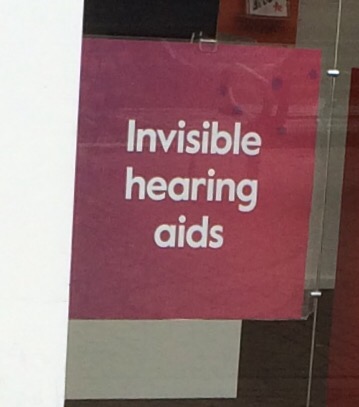
    So when I saw this notice on a shop window this week, I couldn’t help become contemplative…


    It said free hearing tests – great. But invisible hearing aids? There we go again with the stigma that hearing aids and  deafness on a whole isn’t something to be “proud of.” That its something to hide…

    I can understand about comfort and how it’s a generalisation to think of beige hearing aids on elderly people. But why can’t we change this? Funk the hearing aids up a bit, and make the coloured moulds and different designs for adults as well as children.

    Can we somehow increase the visibility of hearing aids in the media that we share with deaf children? So that they’re not just seen as functional but also as attractive, cool, everything that specs can be nowadays! 

    Based on personal experience I feel that making my hearing aids invisible makes my deafness invisible. And just like the visual benefits of having a hearing dog so people are alerted that you might need assistance in an emergency, my hearing aids make me look different because I am

    Sure, looking and being different can make you a target for bullying or abuse and I understand that. But as someone who’s been on both sides, I’ve discovered that there’s no point trying to change or hide something that’s ingrained in me. 

    It reminds me of a deaf girl I knew who refused to sign in public because she was brought up to believe it was embarassing. So despite knowing sign she would only speak in public so as not to attract attention or to highlight she was deaf. 

    It’s down to us to challenge society’s stereotypes of our differences being shameful. Having a unique hearing aid is always a good talking point when meeting new people too ๐Ÿ˜Š 

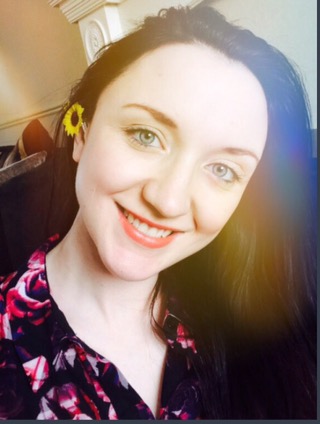
    I’ve made friends with my hearing aids and I try – with the help of creative friends – to “pimp” them up so that they represent me. A friend of mine designs attachments for hearing aids, another one uses nail decals to embellish them and I’m always looking for more inspiration that doesn’t cost the earth. 

    So invisible hearing aids – not for me, thank you.  

    And if you have a unique hearing aid/implant – I want to see it! 


    – my sunflower hearing aid attachment by Vicky Cox. 

  • September. No matter how old I get it always meets me with a “back to school” feeling. And more so this year as my eldest starts nursery school… 

    Gone are the lazy, take-all-our-time-in-the-world style weekday mornings and its hello to school runs, road rage and hurried breakfasts. 

    Not a very optimistic outlook, I know. But I guess there’s a part of me that’s sulking about the fact I have to give up my first born for 15 hours of the week, every week. 

    “You’ll be fine!” My other half insists. “You’ll have more spare time, get more things done, have more…” then he remembers we have a toddler too and stops mid sentence. 

    I have to laugh. It’s normally the child that’s anxious about starting nursery but nope, my son can’t wait. It’s me that’s dreading it. 

    And why? Well, I’ll be honest – I’m just not sure how I’m going to fit in with all those playground mums. 

    I’m the only one that’s deaf. *reverts to feeling about 13 all over again*

    What if nobody talks to me? What if I mishear what someone says and they all laugh and talk about me behind my back? And worse – what if they pity my son for having a deaf Mum? 

    Okay, Beck – stop it. You’re thirty years old, and reverting to childhood anxieties is not going to help. Think logically. 

    Truth be told, the induction earlier this year wasn’t too bad. Most of the other parents looked too worried or occupied to chat and there was one lady who was pretty friendly and easy to lipread, I must admit.

    The school is actually quite knowledgeable about deaf access too as they’ve previously had parents who were deaf, so booking interpreters and texting as opposed to telephoning is all “the norm” for them. 

    And the teachers – from what I’ve seen – don’t seem too fussed about my son’s exposure to sign language but were rather keen to know whether he speaks as well as he signs. Hmph. They’ll soon discover the chatterbox he is. 

    They’ve also told me they have a ‘day book’ in which every day they’ll write down what they learnt about at school, so my son and I can chat about it together at home. This will be so useful. It means if my hearing aid breaks or if I’m particularly tired I won’t be spending hours trying to decipher a new subject from my sons excited chatter….!

    He will love nursery, I’m sure of it. I just need to focus not on being “the only deaf mum” but on just being me. That way, I’ll only make friends with the mums who see me for who I really am. Deafness and all. ๐Ÿ˜Š

    Any other parents tackling “school” for the first time this September?  

  • They say you should never meet your idols. But I met one of mine last week and I was faaaar from disappointed. See below, myself with Caroline Parker or Caro as she’s affectionately known… Sign singing diva and BSL actress. 


    I first saw Caro perform when she was touring the one woman show, “Signs of a Diva” and I went to see it at Wolverhampton’s Arena Theatre. 

    I’ve never seen a show like it.

    The intimacy of the production along with the excellent accessibility (sign language AND captions) meant I drove home that night with so many songs in my head, both old and new.  

    It was the first and probably the only time I have seen a sign singer that not only translates the words but actually embodies the music. She dances, she sways, she accentuates and she pauses… In all the right places. 

    So it was a dream to meet and work with Caro this week on a separate theatrical piece. Chatting to her about sign singing, it was clear how dedicated she is to the art form and how hard she works to create pieces that aren’t just “lyrics translated” but actual living, breathing songs. 

    She treated me and our colleagues to a personal rendition of Bette Midlers “The Rose” and her training in story telling, mime, dance and BSL were all evident. 

    I couldn’t really hear the song playing but I was made aware of its rhythm. The pulse of her movements was addictive, causing us to rock sideways, mesmerised.  Her feet tapped to the keys of the piano, her core swayed as the ballad grew in volume. 

    I explained to Caro how without these visual cues I wouldn’t have understood the music and she agreed that having some kind of musical understanding when you’re sign singing is imperative. Without that, it’s not a song. 

    “If you’re going to perform a sign song, you must incorporate the music. A sign song without the music is BSL poetry.”

    And I couldn’t agree more. Yet this is where the real skill comes in that distinguishes it from BSL poetry,  because in order to fuse BSL with music – a task almost like tapping your head while rubbing your stomach – you have to be aware of BOTH stories the song is telling; lyrically and musically. 

    It’s not easy, I must say. And whether you’re deaf or hearing there will always be elements of a song to work on and explore. Sure, hearing people have the advantage of absorbing musical structures quicker but where there’s a will there’s a way- believe me ๐Ÿ˜‰

    It comes as no surprise then to learn that it took Caro four years to develop and polish her own sign song version of Queen’s Bohemian Rhapsody…! With such an abstract plot and varying musical styles throughout, I can’t say I’m surprised… 

    Caro went on to say that as an artist, you don’t expect other people to simply copy your sign songs, rather – they should develop their own expression of the song. Nobody can or should try and sign in the exact same way as somebody else; songs can mean so many different things to different people.

    And I’m particularly keen to see more sign singers in the coming months. Are YOU a sign singer? Or would you love to perform in a sign singing group? 

    Well… Drum roll please… I’m very excited to say that I will be part of the judging panel for the UK’s very first mainland sign song choir competition next March 11th 2017. 

    Held at the Albert Hall in Nottingham, the event is the first of its kind as there has never been a platform like it for choirs to perform and compete on such a scale. Organised by Simon Astill of Harmoneyes, the event will be fully accessible and have a high energy, carnival like feel to the whole evening. 

    Up to 15 choirs can enter to compete, and audience tickets are now on sale. 

    And to all those entering, you know what I’ll be looking for. Tell the story, make the music come alive and you can’t go far wrong ๐Ÿ˜‰

    Full details can be found here:

    https://nationalsigningchoircompetition.org/

    I can’t wait! 

  • The commercial for Rio Paralympics is out – and boy is it a good one. 

    I knew that the Paralympics had introduced the Superhuman theme back in 2012 but I wasn’t prepared for the sheer greatness of the new “Yes I Can!” advertisement. 

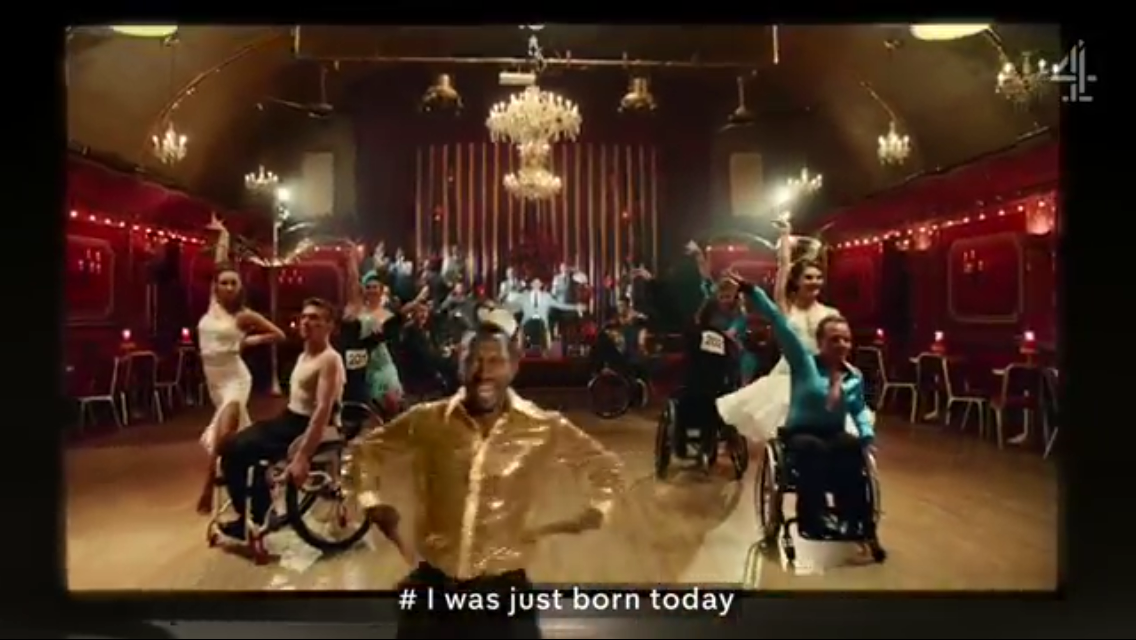
    It features more than 100 people with disabilities; musicians, dancers, office workers, athletes, artists and more.  It’s set to a cover version of Sammy Davis Jrs “Yes I Can” and the words couldn’t be more apt. 

    There is a regular version of the advert, an audio described version, and most importantly a marvellous signed and subtitled version. This is led by deaf artist and actor David Ellington who, although has a role similar to that of an in-vision interpreter, is a star of the advert in his own right.

    Rather than translating the lyrics while remaining fixed in the bottom right screen of the television, David’s movements and signs are choreographed perfectly to match the action simultaneously taking place. He appears to run behind a cheering football fan, dances like a rockstar and even morphs into a karate athlete. The costume and choreography are tremendous and only highlight just how talented David is, portraying so many characters in one song. 

    It really is a delight for the eyes. Working with David to choreograph the signed version was Alim Jayda, an esteemed actor and a native user of BSL due to having deaf parents. 

    Speaking to Alim I discovered he was sought out by a theatre company who were on the hunt for Channel 4 for artists with sign & choreography skills. With it being such a huge opportunity for any artist but with the added responsibility of ensuring accessibility for deaf viewers, Alim explained the challenges they worked to overcome; 

    “My main aim was to make sure that it was completely accessible. It was important to myself, David and the company to ensure that we were as respectful to the translation as we were the artistic vision. We wanted to make sure there was lots of choreography and charisma but needed to make sure that this did not affect the signing reception.

    The hardest challenge was making sure the BSL was exactly on time with the lyrics which is unusual.

    With interpreted pieces. I stood opposite David on the shoot day as a guide to ensure everything was on time and give him markers. He has an overwhelming natural ability of being able to understanding the rhythm of the song anyway. 

    All hearingies were given industrial ear phones so the music could be blared allowing David to feel the vibrations.”

    And if you check out the Behind the Scenes video you can even see Alim wearing those ear phones while David rehearsed! 

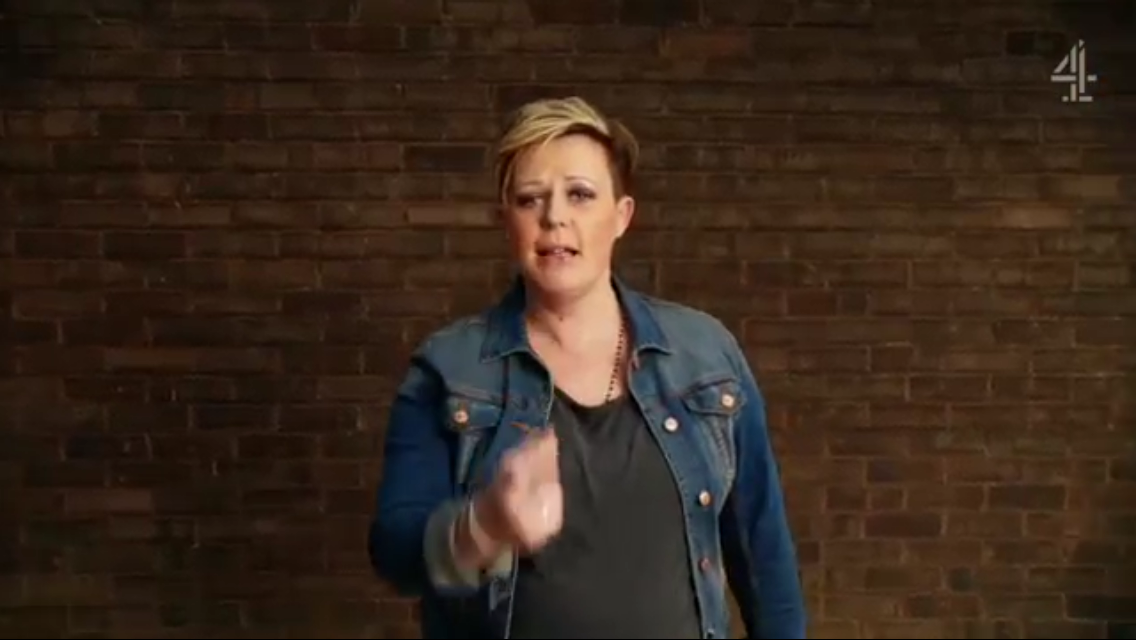
    Some people have asked me why I think Channel 4 have made separate versions, not one completely accessible version for all… And I don’t have an answer yet for that BUT if you catch the regular version watch out for a familiar face as deaf sign singer Fletch@ is featured signing “Yes I Can!” 


    That’s deaf representation in the main commercial as well as a brilliantly signed version for all for us too. 

    I love the superhumans, and that’s a super advert Channel 4. More please! 

    Watch out as the advert airs on Channel 4 at 9pm tonight. 

    https://m.youtube.com/watch?v=Y76hSxoxClg – the signed and subtitled version 

    https://m.youtube.com/watch?v=IocLkk3aYlk – without sign language 

    https://m.youtube.com/watch?v=EKGOWavFvHc – audio described 

  • It was only a chair. 

    It was just the placement of the chair that “told” others I was an – ahem – inbetweener

    I was at a children’s party, feeding my daughter while my son danced about when I noticed a deaf guy pointing at me. 

    He was asking others who had congregated in a corner, “Who’s that? Is she hearing? She’s not deaf is she?” They all looked. But before they could answer I piped up. 

    “I’m deaf, and I’ve seen you around before.” I signed to him. He looked at me quizzically. His wife wandered over to see what the matter was then proceeded to tell him how they knew me. 

    “Oh! I remember now!” The guy exclaimed. “You’re one of them people, you can do both – fitzafitza and sign.” 

    Fitzafitza – he was referring to my speech. 

    “Erm, yes,” I replied, feeling flummoxed. “I suppose I can.” 

    “That’s why you’re sitting there then!” He concluded, as though the placement of my chair really mattered. 

    I looked around. To the left of me was four hearing mothers and to my right was a group of deaf parents. 

    How ironic. If ever there was a visual explanation to describe my place in the world, this was it. Bang in the middle. 

    Suddenly I felt awkward and self conscious. Is this really how people see me? Not quite fitting in?

    Sure, that day I did chat jovially to my deaf friends and I love their company but it’s true – I do feel a bit different. And whilst I’m happy to get to know other hearing people there’s usually the intial communication stumbles. 

    And of course there’s the hearing people who run a mile because they’re scared of deaf people – so I don’t get the chance to know them anyway!  

    It’s a bit of a conundrum really. 

    I’m not quite this but I’m not quite that. In the deaf community’s eyes perhaps I’m not a true ‘big D’ deaf person. But then maybe to the hearing world there’s no denying I am deaf.

    Although I’m obviously, slap-you-in-the-face, clearly deaf, I’ll never be able to hide my “hearing-ness” or Hearing Culture I should say.

     The oral use of English, SSE based signs, love of music and the little quirks that my deaf friends say make me “look hearing” – the polite, reserved nature in social settings. 

    And then in opposition to all that, there’s no denying my Deaf Culture either. The visual humour, noticing things others wouldn’t, love of sign language and of course the exaggerated lip patterns or animated facial expressions when in conversation. 

    It’s just who I am. 

    I didn’t want to be an inbetweener growing up. Oh no.  I wanted to fit in one camp only. I thought maybe if I was more deaf the support at school would be more straightforward and I’d have more deaf friends. I’d be going to the deaf club instead of dance lessons, not missing out on the youth activities at the deaf club like I always did… 

    But then in the privacy of my bedroom I’d wish that I was hearing so I could go on Pop Idol (the show before X Factor ๐Ÿ˜‰ ) and follow my dreams to work in the West End. Singing into my hairbrush with the stereo turned high and dreaming of a musical life. 

    But those simple, straightforward dreams weren’t meant to be, were they? This is my plan. 

    So, to the guy who pointed me out and asked – in a beautifully blunt Deaf Culture way – why I was sitting where I was… Thanks. It may have been purely coincidental but I believe that awkward conversations such as the one with yourself are only catalysts for getting us to accept or move on from something. 

    So yes, I am sitting in the middle. And yes, I do go in both worlds – not fully perhaps, but it’s okay with me. I can work with it ๐Ÿ˜Š

    And it’s Rebecca, by the way. I do hope you remember me next time. ๐Ÿ˜‰

    Any more inbetweeners out there? 

  • “Deafness does not mean that you canโ€™t hear, only that there is something wrong with the ears. Even someone who is totally deaf can still hear/feel soundsโ€. (Glennie, 2010)

    We had a visitor one day when I was at Mary Hare school for the deaf. She had wild hair and was moving about while she made – what I perceived to be – a “racket.” 

    There was quite an excited hubbub regarding her presence, especially amongst the teachers. But with the lady playing what sounded like classical music, I was far from interested. 

    That lady was Dame Evelyn Glennie. World renowned percussionist and perhaps one of the most well known musicians who is deaf. 

    I say “who is deaf” rather than “deaf musician” because that’s how she writes about herself; not at all fussed by her deafness and not wishing to be labelled by it in any way. I know this because I studied her briefly as part of my University dissertation and discovered a statement she issued to journalists explaining her hearing loss and indicating that she no longer wanted to be asked about her deafness. 

     โ€˜If you want to know about deafness, you should interview an audiologist. My speciality is musicโ€™. Extract from Hearing Essay by Evelyn Glennie

    I saw her recently in video footage by BBC’s See Hear with another acclaimed deaf person, American rapper Sean Forbes. 

    Based in Detroit, Sean is a profoundly deaf rapper who got signed up in 2010 by the same record company that launched Eminem. 

    In 2013 Sean was crowned outstanding hip-hop artist of the year at the Detroit Music Awards and the millions of hits he’s notched up on his Facebook and YouTube channel show how much of a storm he is causing as an artist. 

    The footage by See Hear explained how, inspired by his musical achievements over in the States and curious to explore the genre of rap, Evelyn contacted Sean and enquired about the possibility of a collaboration. 

    Sean and his producer Jake Bass – having already heard of Evelynn’s work – were equally eager and flew over to the UK.

    Now, I’m a little bit more in awe of Sean’s work (sorry Evelyn!) purely because the musical style is more to my taste. The fact that Sean signs his lyrics and makes funky accessible music videos means I have an easier time enjoying his songs than I do trying to listen to classical percussion. 

    My hearing aids don’t make easy sense of the many layers of classical music. While Evelyn says that all notes, no matter how subtle, can be felt physically, it’s not a process that I find easy. 

    It does seem odd at first to comprehend how such a formal genre can be fused with one that began in “the streets” – will it have the same impact visually and audibly? Will either style get lost in the other? 

    Yet even despite being from alternate countries; Scotland and the USA and having such different backgrounds, Evelyn and Sean seem so at ease in another’s presence it would be easy to assume they’ve worked together for many years. They even appeared to lipread each other’s accents effortlessly! 

    So I have an inkling that this might just work… 

    Sean’s hearing producer, Jake Bass, has been working alongside Evelyn  to compose music for Sean’s song lyrics and the whole project will culminate in a 2017 tour featuring a 25 piece orchestra. 

    So that’s popular rap and classical music fused together, written and performed by musicians who happen to be deaf. 

    I have no idea if I’ll like this combination or even if I’ll understand it. But I know for sure that with two musical prodigys like this, I’ll certainly be going to see it. 

    “The best part is that being Deaf isn’t even part of the equation, it’s what brought us together.” Sean Forbes 


    Sean Forbes, Dame Evelyn Glennie and Jake Bass.